
7 Essential Skills Every Child Needs To Thrive In A Digital World
Updated: Mar 19
With Parent Tips and Age-Based Activities for Real-World Learning
The world our children are growing up in is changing faster than ever. Artificial intelligence is transforming industries, automation is reshaping jobs, and digital platforms influence how we learn, work, communicate, and even think.
The question is no longer, “What career will my child choose?”
The more useful question is, “What skills will help my child adapt, grow, and thrive in any future?”
Academic knowledge remains important. But today, future-ready skills for kids, such as adaptability, creativity, critical thinking, and digital literacy are just as essential as grades.
According to the World Economic Forum, analytical thinking, creativity, and technological literacy are among the most in-demand capabilities in the global workforce.
This guide outlines 7 essential skills every child needs with practical, age-appropriate ways to build them through hands-on learning.

1. Digital & AI Literacy
From Screen User to Smart Creator
Children must move beyond passive screen use and learn how digital systems work.
Digital literacy for kids include:
Understanding how algorithms and AI tools function
Recognizing how data is collected and used
Practicing online safety and digital responsibility
Children who understand technology become creators, not just consumers.
According to UNESCO, more than 90% of jobs worldwide now require basic digital skills. Children without digital literacy risk being left behind.
💡Parent tip: Shift from scrolling to building.
Try these together:
Ages 6–8: Sort patterns with simple no-code AI tools like Teachable Machine.
Ages 9–12: Design ethical games in Roblox and discuss fairness
Ages 13–16: Build basic apps, chatbots, or automation projects
2. Critical Thinking
Question, Analyze, Decide
In an age of misinformation, critical thinking is a survival skill. Critical thinking helps children make informed decisions and solve problems logically.
It strengthens the ability to question, analyze, and evaluate and protects children academically, socially, and digitally.
💡Parent tip:
Play "why" games: "Why did the robot fail? How can we fix it?"
Debug coding projects step-by-step to learn iteration.
Discuss and improve story drafts: "Does this story feel real? Why?" In publishing projects, a child learns to evaluate and improve when a story is reviewed and revised multiple times
3. Creativity & Innovation
The Human Edge in an AI World
Routine tasks can be automated. Original thinking cannot
Routine tasks are increasingly automated, but creative thinking is not. Creativity, whether through coding, storytelling, or entrepreneurship, allows children to generate original ideas, combine concepts in new ways, design innovative solutions, and express themselves confidently.
AI can generate options. Humans create vision.
💡Parent tip:
Ask, "What if your drawing could talk?"
Praise messy first tries.
Encourage experimentation.
Progress matters more than perfection.
Ages 6–8: Combine storytelling with simple robotics. For example, one can draw stories and then add Lego robotics movements.
Ages 9–12: Write and publish mini-books or remix ideas in Roblox
Ages 13–16: Design projects from personal ideas like apps or finance trackers
4. Problem-Solving & Logical Thinking
Turning “I Can’t” Into “I’ll Figure It Out”
The jobs of the future will require solving complex, unfamiliar challenges. Learning to break problems into steps, test solutions, learn from failure, and improve through iteration builds resilience and analytical strength.
Future careers will reward structured thinking and resilience.
💡Parent tip: Work on these together.
Tangible wins even when small build persistence.
Lego robotics: Program robots to complete maze challenges
Coding for kids: Fix coding glitches step-by-step
Set and track savings goals in finance projects
5. Financial Literacy
Money Skills for a Digital Economy
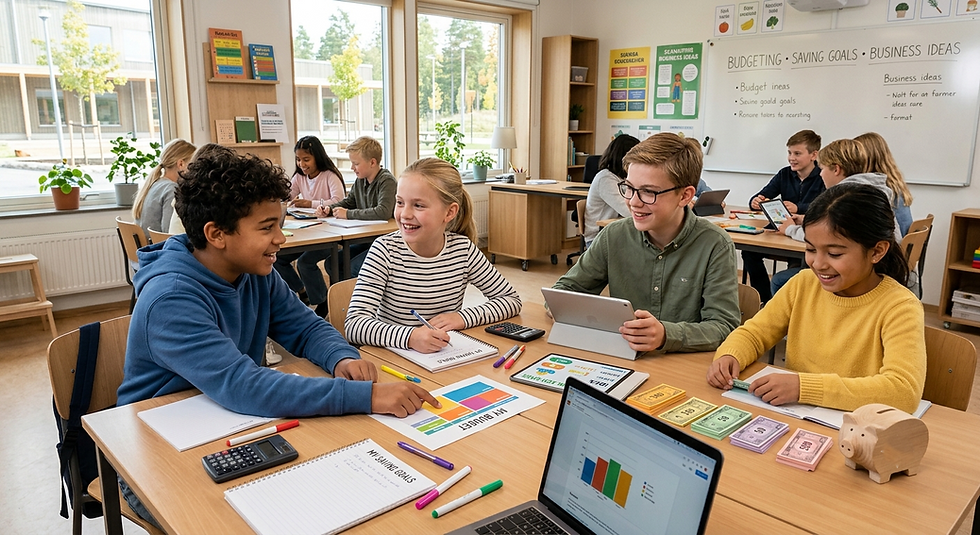
Financial literacy for children is no longer optional. In a digital economy of online payments, subscriptions, and digital assets, financial literacy teaches saving, investing, thoughtful spending, discipline, and entrepreneurial awareness.
Money skills build independence and long-term thinking.
According to the OECD PISA 2022 financial literacy assessment, 18% of teenagers lack basic money-management knowledge, even in developed countries.
💡Parent tip: Financial confidence begins early. Associate concepts to real allowance decisions.
How to build it:
Ages 6–8: Use save/spend jars. Sort play money into "save/spend" jars.
Ages 9–12: Plan budgets for digital purchases. Example: Budget Roblox in-game purchases.
Ages 13–16: Simulate investments and track financial goals.
6. Communication & Collaboration
Skills for a Connected World
The future workplace is global, digital, and team-based. While technology supports productivity, collaboration drives innovation.
The World Economic Forum consistently ranks collaboration and communication among top employability skills.
Children must learn to:
Express ideas clearly
Listen actively
Present confidently
Work effectively in groups
How to build communication and collaboration:
Co-create stories for book publishing
Participate in group robotics challenges
Pitch game or project ideas to peers and take feedback
Teamwork multiplies learning.
7. Adaptability & Growth Mindset
Thriving in Change
Perhaps one of the most important future skills is adaptability. Future-ready kids develop:
Confidence in learning new skills
Resilience after setbacks
Curiosity toward emerging technologies
Comfort with change
Technology evolves quickly. Adaptable children stay ahead and turn uncertainty into opportunity.
Research from McKinsey & Company suggests that automation will significantly reshape many current job roles, requiring workers to reskill multiple times in their careers.
💡Parent tip:
Tech evolves fast, resilient kids pivot easily.
Praise effort: "You kept trying, that's the win!"
Encourage revisions instead of quick success
Normalize mistakes in coding or robotics
Adapt Roblox designs to group input.
Age-Based Roadmap for Building Future Skills

💡Parenting Action Plan: Start small. Even 15-minute focused sessions build momentum.
Pick 2 Skills: Tie to your child's interests (stories? Try book publishing).
Curate Tools: Kid-safe like Scratch, Roblox Studio, or Lego kits.
Reflect Weekly: "What worked? What to tweak?"
Add Structure: Enroll in programs for guided goals and community.
Prepared for Life, Not Just Jobs
The future can't be predicted, but it can be prepared for. Future-ready children aren't just job-ready, they're life-ready. They think independently, use technology responsibly, solve meaningful problems, and contribute positively.
Equip children with the right skills today, and they will navigate tomorrow with confidence, independence, and purpose.
Which future skill would you focus on first?


Comments