
AI for Kids: A Parent’s Guide to Raising Future-Ready Thinkers
Updated: Mar 19
Artificial Intelligence (AI) may sound complex and intimidating.
But here’s the reality:
AI is already part of children’s daily digital interactions.
From voice assistants and YouTube recommendations to smart search results and gaming algorithms, AI is quietly shaping the digital world children grow up in.
The real question isn’t whether kids should learn about AI, it is whether they will understand it or just consume it passively.
Breaking down Artificial Intelligence for kids
Artificial Intelligence simply means:
Technology that can “learn” from data and make decisions or predictions.
In other words, it's a way for computers to recognize patterns, make sense of information, and respond intelligently, much like how we learn from experience.
For children, this can be explained through everyday examples they already know:
When Netflix suggests a movie you might like, that’s AI noticing your preferences.
When a video game adjusts its difficulty level as you get better, that’s AI reacting to your performance.
When a chatbot answers your questions instantly, that’s AI understanding and replying using patterns in language.
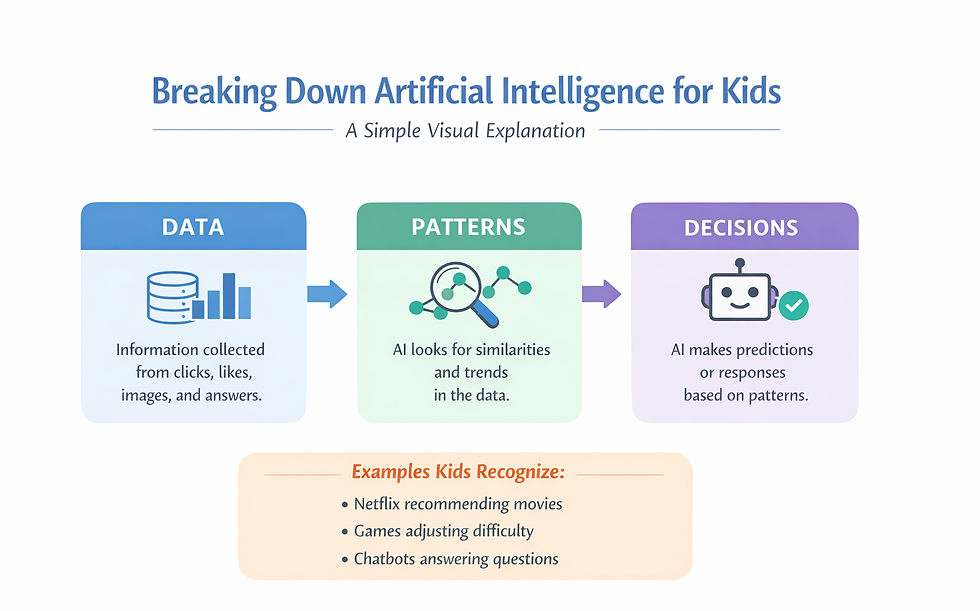
AI might seem magical, but in reality, it is math, logic, and patterns working together. Once children see it that way, the mystery fades and is replaced by curiosity and understanding.
Why Early AI Education Matters for Children?
Research from institutions such as the World Economic Forum highlights AI literacy, problem-solving, and digital adaptability as some of the most essential future skills children can develop.
But teaching AI isn’t only about preparing kids for future jobs it is about nurturing the way they think and interact with technology today. When children learn about AI, they also build:
Logical thinking: understanding how systems follow rules and make decisions.
Curiosity: asking questions about how apps, games, and tools work.
Ethical awareness: learning how to use technology responsibly.
Creativity: imagining how AI can solve real-world problems.
Confidence: feeling comfortable exploring and using technology.
Instead of worrying, “Will AI replace humans?”, a more powerful question is, “How can our children learn to work alongside AI responsibly and creatively?”
The Biggest Myth: “AI Is Too Advanced for Kids”
Many parents and teachers hesitate to introduce AI because it sounds overly technical.
But teaching AI to children doesn’t mean diving into advanced coding or complex math equations. It means building a foundation by helping kids understand:
What data is (the information machines learn from)
How patterns work (how AI recognizes similarities and trends)
How machines make decisions (using algorithms)
Why ethics matter (because AI affects real people and communities)
Even young kids in primary school can begin exploring these ideas through stories, games, role-play, and hands-on experiments. The key is to provide age-appropriate learning that connects to their world.
How to Introduce AI at Different Ages
Ages 6–8
Awareness Through Play
Pattern recognition games
Sorting activities
"How YouTube knows" discussions
Simple visual coding
Ages 9–12
Exploration and Creation
Beginner coding projects
Simple chatbots
Image recognition demos
AI in daily life
Ages 13+
Critical Thinking and Ethics
AI bias discussions
Real-world case studies
Small AI-projects
Understanding data privacy
Passive Use vs Purposeful Understanding
There is a major difference between using AI-powered apps and understanding how AI works beneath the surface. When children only consume AI-generated recommendations or content, they remain passive users. But when they start building, experimenting, and asking why and how, they begin to transform into creators and innovators.
It is this shift in mindset that truly matters.
Research from the Center on the Developing Child at Harvard University highlights that active engagement strengthens deeper cognitive development. Children learn best when they build and reflect, not when they scroll endlessly.
Giving children opportunities to create with AI doesn’t just increase knowledge. It cultivates curiosity, resilience, and ownership over the tools that shape their world.
Why Structured Learning Matters
AI is powerful. And powerful tools require guidance and intentional learning.
Parents often wonder,
“What would my child actually do in an AI class?”
The answer depends on structure.
Random tutorials may introduce isolated concepts. But thoughtfully designed programs help children connect ideas logically, understand ethical implications, and build real projects.
Instead of just watching videos about AI, children can:
Train simple image-recognition models to identify objects.
Build AI-powered games that respond intelligently.
Create chatbots that simulate conversation.
Experiment with how AI systems learn from data they provide.
When AI learning becomes hands-on, it stops feeling abstract and starts feeling empowering, enriching, and fun.
The Real Goal: Confidence, Not Complexity
The goal of AI education is not to turn every child into a tech expert, but to raise confident and critical users of technology.
Children who understand AI:
Ask insightful questions
Think critically about digital content
Recognize misinformation
Adapt to emerging technologies
Use tools responsibly and ethically
AI literacy isn’t about replacing childhood with technology but about empowering children to understand and shape the digital world they already live in.
A Small Shift Today Prepares for a Confident Tomorrow
AI isn’t part of some distant future. It is already woven into everyday life. The earlier children understand it, the more confident they become in navigating a digital world.
The best part? Children are naturally curious. They adapt quickly and they love building things. With the right guidance, AI doesn’t have to feel intimidating.
AI can become a doorway to creativity, ethics, and innovation.
For parents looking for a clear starting point, GowReads offers AI Ninjas, a structured, in-person AI course for kids aged 6–16. The course is built on a simple belief:
AI does not have to be complicated. It can be experiential.
The program incorporates playful, hands-on activities that make learning engaging and accessible to kids. Because raising future-ready thinkers starts not just by surrounding them with technology but by equipping them with tools to understand and shape the world around them.

Comments