
Screen Time for Kids: From Scrolling to Skill-Building
Screen Time Isn’t the Enemy, Passive Screen Time Is
Surrounded by YouTube, gaming apps, social media, and endless streaming platforms, children today spend significantly more time on screens than any earlier generation.

It’s no surprise that one of the most common questions modern parents ask is:
“Is screen time bad for my child?”
But what if we are asking the wrong question? What if the real issue isn’t screen time itself but whether it’s passive or purposeful?
Studies from the Center on the Developing Child at Harvard University show that active engagement supports cognitive growth, while passive consumption can reduce attention span when overused. Similarly, the American Academy of Pediatrics (AAP) emphasizes that content quality matters more than time alone. Educational and interactive content has different outcomes compared to passive entertainment. In other words, not all screen time affects children the same way.
How Much Screen Time Is "Healthy"?
The World Health Organization suggests:
Limited screen exposure for children under 5
Structured, high-quality content for older children
However, many experts today emphasize balanced and intentional use rather than rigid time limits. The real goal is not simply reducing screen time, it is increasing skill-building screen time instead of passive consumption time. Screens can either drain time or develop skills. So the objective is not to eliminate technology. It is to transform screen time into skill time.
The Cognitive Impact of Passive vs. Active Screen Time
Excessive passive screen exposure has been linked to shorter attention spans, reduced sleep quality, lower physical activity levels, and increased emotional reactivity. However, research also shows that interactive, creative digital experiences can improve problem-solving skills, support early coding logic, enhance collaboration, and build essential digital literacy. The difference lies not in the screen-time itself but in how screens are used.
In this guide you will discover:
The difference between passive and productive screen time
Why turning screen time into skill time matters
Practical, easy-to-implement strategies for parents
Passive vs Productive Screen Time
Let us simplify this difference.
Passive Screen Time | Productive Screen Time |
Endless scrolling | Building a game |
Watching random videos | Creating a digital story |
Auto-play cartoons | Coding a robot |
Short-form dopamine hits | Designing a website |
Gaming without purpose | Game development |
Passive screen time consumes. Productive screen time creates.
Why Turning Screen Time into Skill Time Matters
The future belongs to problem-solvers, creators, and digital thinkers.
The World Is Becoming AI-Driven
Artificial Intelligence, automation, and digital platforms are transforming industries. According to the World Economic Forum (Future of Jobs Report), digital literacy, analytical thinking, and creativity are among the top skills for the next decade.
Children who learn coding fundamentals, logical reasoning, AI awareness, and digital storytelling are not just “tech-savvy”, they are future-ready.
Creativity Builds Confidence
When children create something digitally, such as a game, animation, podcast, or interactive story, they solve real problems, test ideas, handle trial and error, and experience accomplishment. Creation builds ownership which in turn builds confidence.
Structured Digital Learning Improves Focus
Contrary to popular belief, structured digital learning can actually improve attention and executive function. Research suggests that goal-oriented digital tasks improve sustained focus compared to passive video watching.
Tips to transform Screen Time into Skill Time
Shift from Consumption to Creation
Instead of | Encourage |
Watching gaming videos | Designing a simple game |
Scrolling TikTok | Creating a short educational video |
Random YouTube browsing | Learning animation basics |
Parent Strategy:
Ask your child weekly: “What did you create on your screen this week?”
Introduce Coding Early
Coding is not just about becoming a programmer. It builds:
Logical thinking
Sequencing
Pattern recognition
Problem-solving
Debugging resilience
Platforms like Scratch (for younger children) and beginner-friendly coding programs make it approachable. Research from the University of Chicago shows early coding exposure enhances computational thinking, a skill transferable to math and science.
Teach AI Literacy (Not Just Usage)
Children already use AI tools but do they understand them?
AI literacy includes understanding how algorithms work, knowing what bias means, recognizing misinformation, and using AI ethically. Teaching children to question how digital systems function builds critical thinking.
Blend Physical and Digital Learning
Skill time doesn’t mean replacing physical play. It means blending both.
Examples:
Design a digital treasure map and play it outside
Code a robot and test it physically
Create a story and act it out
Studies show hybrid learning improves retention compared to screen-only instruction.
Set Intentional Screen Rules
Instead of saying: “No more screen time.”
Try: “Let’s use screen time to build something.”
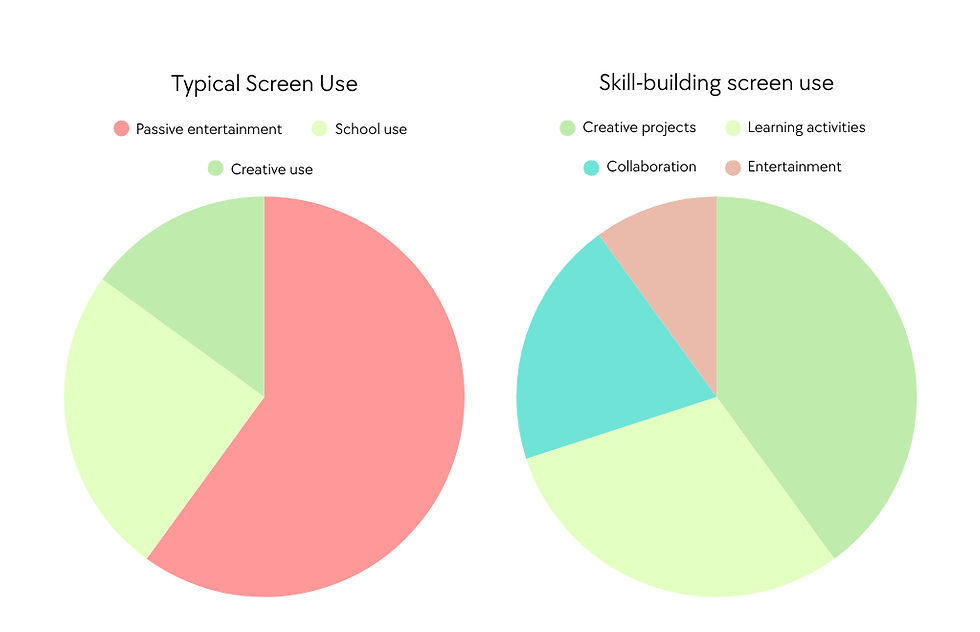
Create categories like
40% creative
30% learning
20% collaboration
10% entertainment
This teaches self-regulation rather than restriction.
The Long-Term Impact of Skill-Based Screen Time
When children build instead of scroll, question instead of consume, and create instead of copy, they develop digital confidence, cognitive flexibility, adaptability, and real-world readiness. Screen time is inevitable. Skill time is intentional. It is the difference that shapes their future.

Ready to Turn Screen Time into Skill Time?
If you’re looking for structured, hands-on programs that transform screen time into real, future-ready skills from coding and AI literacy to creative storytelling, explore our upcoming camps, designed to help children move from passive users to confident creators in the digital age.

By turning screen time into skill time, we empower children not just to participate in the digital world, but to shape it. Our courses build problem-solving abilities, digital confidence, and the skills needed to thrive in today’s technology-driven world.


Comments