
Art and Sculpture for Kids: Creative Learning Through Summer Camp Activities
Sculpture helps children explore texture, shape, and geometry through hands-on creativity. By working with clay, paper, recycled materials, and mixed media, children develop spatial awareness, fine motor skills, problem-solving abilities, and artistic confidence. In a summer camp setting, sculpture becomes both a creative outlet and a powerful learning experience.
Why Sculpture Is More Than Just Art and Craft
When parents think about summer activities for kids, sports and outdoor play often come to mind first. However, creative activities like sculpture offer equally important developmental benefits. Sculpture combines art, design, and problem-solving in a way that encourages children to think differently. Unlike drawing on a flat page, sculpture allows children to work in three dimensions. They build, shape, balance, and experiment with materials they can physically touch and transform. This process helps children understand how objects occupy space, how shapes connect, and how structure affects design. It also encourages patience, focus, and independent thinking.
At GowReads Summer Camp in Stockholm, art and craft are not treated as simple free-time activities. They are meaningful learning experiences where children develop important creative and cognitive skills through hands-on exploration.
Learning Geometry Through Creative Play
Geometry can feel abstract when it is taught only through books and worksheets. Concepts like symmetry, balance, proportion, and structure are often easier to understand when children can see and build them. Sculpture makes these ideas visible. When a child creates a paper structure, shapes clay, or builds with recycled materials, they naturally begin to apply geometric thinking. They notice how triangles create strength, how circles soften design, and how balance determines whether a structure stands or falls. Without even realizing it, they are learning geometry through creative play.
Such hands-on learning is powerful because it feels playful rather than academic. Children remember what they build because they experience the lesson physically as well as mentally.
How Texture Builds Sensory Awareness and Fine Motor Skills
Texture is one of the most valuable parts of sculpture. Smooth clay, rough cardboard, soft paper, and layered materials create different sensory experiences that help children become more observant and expressive.
Working with texture strengthens fine motor skills, hand coordination, and concentration. It also helps children understand that art is not only about how something looks, but also about how it feels and how materials create emotion and meaning. For younger learners especially, this sensory engagement supports patience and focus. Sculpture slows children down and encourages exploration instead of rushing toward a perfect result.
Building Creativity, Confidence, and Problem-Solving Skills
One of the greatest benefits of sculpture is that it teaches children how to solve problems creatively. A sculpture may collapse, a material may not behave as expected, or a design may need to change halfway through. Instead of seeing this as failure, children learn to adapt. They test new ideas, rebuild, and improve their work. This process builds resilience and confidence. Children begin to trust their own ideas and understand that mistakes are part of learning.
In a world where many children feel pressure to get everything right, sculpture offers freedom. There is no single correct outcome. Every project is unique, and that builds creative confidence.
Why Art and Craft Matter During Summer Break
Summer break is the ideal time for creative learning because children have the freedom to explore without academic pressure.
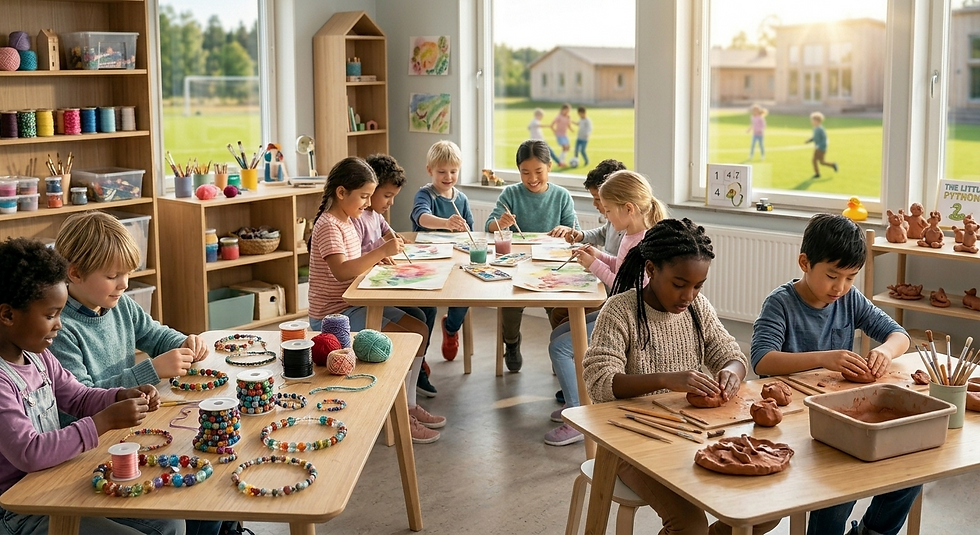
Art and craft activities balance physical movement with quiet focus and imagination. A strong summer camp experience includes both. Children may spend part of the day in sports and outdoor play, and another part building sculptures, creating mixed-media projects, or exploring design. This balance keeps them mentally and physically engaged while reducing excessive screen time. Instead of passive entertainment, children experience active creativity and meaningful learning.
Sculpture as Part of a Holistic Summer Camp Experience
At GowReads Summer Camp, sculpture is more than an art activity. It is part of a larger learning journey that combines STEAM, creativity, and personal development. Children are encouraged to think, build, experiment, and collaborate across activities, whether they are coding, playing sports, building robotics projects, or creating sculptures.
Art and craft are not just hobbies; they help children develop observation, patience, confidence, and original thinking. Sculpture, in particular, brings together creativity and logic in a powerful way. Through hands-on projects, children strengthen problem-solving skills, fine motor control, spatial awareness, and creative independence. They learn how to adapt, rebuild, and trust their own ideas.
By exploring texture and geometry through sculpture, children discover that creativity is not separate from learning. It is in fact one of the strongest ways to learn. At GowReads Summer Camp in Stockholm, the goal is not simply to keep children busy during summer, but to help them grow into curious, confident, and future-ready learners.

Comments