
Why Hands-On Learning Still Matters in a Digital World
Hands-on learning remains essential because children learn best through interaction, experimentation, collaboration, and real-world experiences. While digital tools provide access to information, physical learning helps children develop critical thinking, communication, creativity, confidence, and social skills that are difficult to build through screens alone.
In today's technology-driven world, children can learn almost anything through a screen. Coding tutorials, AI tools, educational apps, and video lessons are available instantly, often with just a few clicks. Digital learning has transformed education, giving children unprecedented access to information, creativity, and skill-building opportunities. But as learning becomes increasingly virtual, an important question continues to emerge for parents and educators alike: does physical learning still matter?
The answer is yes, perhaps now more than ever.
While digital platforms provide access to information, true learning often happens through interaction, movement, collaboration, and hands-on experiences. Children do not simply absorb knowledge like machines downloading files. They learn by doing, experimenting, questioning, building, and engaging with the world around them. As artificial intelligence, automation, and digital tools become increasingly integrated into everyday life, the goal is not to reject technology. The challenge is finding the right balance between digital learning and real-world experiences that help children apply knowledge in meaningful ways.
Why Hands-On Learning Creates Deeper Engagement
One of the biggest differences between online learning and physical learning is the depth of attention children experience. Digital environments are filled with distractions. Notifications, games, videos, messages, and endless scrolling constantly compete for focus. Even educational screen time can quickly become fragmented. A child watching a coding tutorial at home is often only one click away from distraction.
Physical classrooms, workshops, and learning spaces create a different kind of environment. When children enter a robotics class, a Roblox game development workshop, a creative writing session, or a financial literacy program, they step into a dedicated space designed for concentration, participation, and exploration. The environment itself signals that it is time to think, create, collaborate, and solve problems. This shift in attention often leads to deeper engagement and better retention of knowledge.

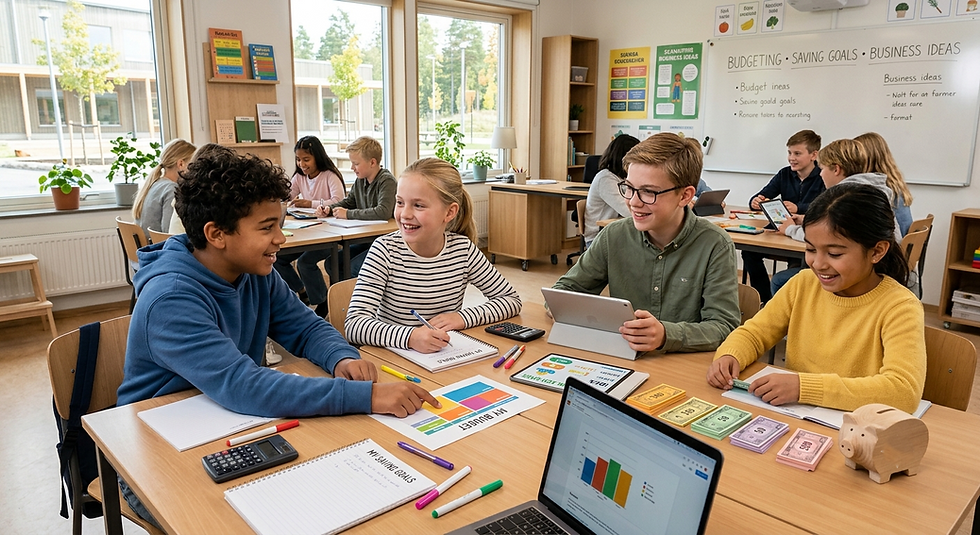
Research also suggests that children learn more effectively when physical experiences are involved. Building a LEGO robot, sketching ideas on paper, creating a book prototype, managing a budgeting challenge, or testing a coding project alongside classmates activates both cognitive and motor skills. Learning becomes connected to action and experience rather than observation alone.
How Physical Learning Builds Future-Ready Skills
Future-ready skills are rarely developed through passive watching. Problem-solving, communication, creativity, teamwork, adaptability, and resilience grow through interaction and experimentation. A child debugging a robotics project with peers learns far more than coding syntax. They learn patience, persistence, collaboration, and confidence.
Similarly, a child presenting a project, discussing ideas with classmates, or working through a challenge in a group develops communication and social skills that are difficult to replicate through independent screen-based learning. These human-centred skills are becoming increasingly valuable in a world where information is abundant and technology continues to automate routine tasks. The future will belong not only to those who can access information, but to those who can think critically, work effectively with others, and apply knowledge creatively in real-world situations.
The Social Benefits of In-Person Learning
The social dimension of physical learning is another reason it remains essential. Online courses can deliver information efficiently, but they often struggle to recreate genuine human connection. In a live learning environment, growth happens through conversations, shared excitement, spontaneous questions, teamwork, and collaborative discovery. Children observe body language, communicate ideas in real time, negotiate different viewpoints, and build confidence through interaction.
Instructor-led learning also provides immediate feedback and support. An educator can quickly notice confusion, hesitation, curiosity, or enthusiasm and adapt the learning experience accordingly. Questions can be answered in the moment, and challenges can become opportunities for deeper learning. These interactions create a richer educational experience than pre-recorded lessons alone.
Can Children Learn Everything Through Screens?
Digital platforms offer remarkable educational opportunities, but learning is about more than information delivery. Children also need opportunities to communicate, collaborate, create, experiment, and apply knowledge in real-world situations. They need spaces where mistakes become learning opportunities, where ideas can be discussed openly, and where curiosity can be explored together.
Many of these experiences are more difficult to replicate through screens alone. Technology can support learning, but it cannot fully replace the value of human interaction, shared experiences, and hands-on exploration.
Finding Balance Between Technology and Hands-On Learning
Physical learning also helps restore balance in children's relationship with technology. The modern challenge is not simply screen time. It is the quality of screen time. Children already spend large portions of their lives surrounded by devices. Increasingly, parents are looking for opportunities where technology becomes purposeful rather than passive.
Whether children are designing games, programming robots, developing coding projects, exploring AI tools, or learning financial literacy, they benefit most when digital learning is combined with creativity, discussion, movement, and real-world collaboration. The goal is not to eliminate screens. The goal is to transform screen time into active learning, creation, and skill development.
Why Physical Learning Matters Even More in the Age of AI
As AI tools become increasingly capable of providing information instantly, uniquely human skills become even more valuable. Creativity, collaboration, communication, empathy, critical thinking, and ethical decision-making are not developed simply through access to information. They are developed through experience, interaction, reflection, and practice.
Artificial intelligence can help children access knowledge more quickly than ever before. But understanding how to apply that knowledge, question it, discuss it, and build upon it remains fundamentally human. This is why physical learning may become even more important in the years ahead.
As education continues to evolve, children will need both digital fluency and strong human skills. They will need to know how to use technology effectively while also developing the creativity, confidence, and critical thinking needed to navigate an increasingly complex world. Technology can provide children with access to endless information. Hands-on learning helps them turn that information into understanding. By building, creating, collaborating, and experimenting alongside others, children develop the confidence, creativity, and critical thinking skills needed to thrive in a rapidly changing world.


Comments