
Raising Money-Smart Kids
Children today grow up in a world of digital payments, in-app purchases, online shopping, and cashless transactions. Money moves invisibly through cards, phones, and apps. While children see money being spent, many never truly understand how money works. Just like reading, coding, or problem-solving, financial literacy for kids is a foundational life skill. The earlier children learn about budgeting, saving, and decision-making, the more confident and responsible they become in adulthood.
In today’s rapidly changing economy, financial education is no longer optional. It is an essential preparation for real life.
What Is Financial Literacy for Kids?
Financial literacy is not about turning children into investors or stock traders. It is teaching life skills.
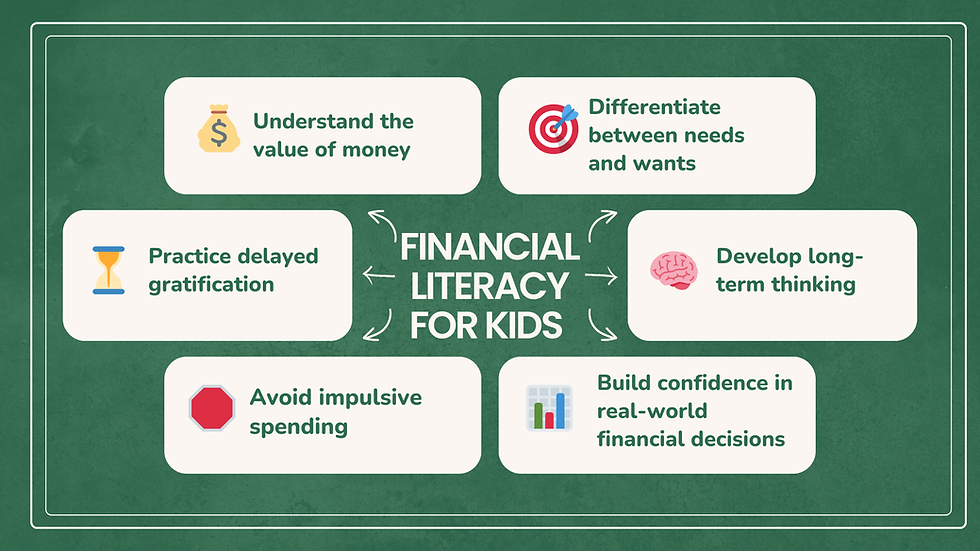
When children understand money, they don’t just spend better, they think better.
They begin asking meaningful questions:
Where does money come from?
Why can’t we print unlimited money?
Why do prices rise?
Why should I save instead of spending everything?
These questions not only build economic awareness but also critical thinking skills.
Why Is Financial Education Important in Childhood?
Money Habits Form Early: Research from the University of Cambridge shows that key money habits are formed by around age 7. Attitudes toward saving, spending, and planning develop long before children earn their first paycheck.
When financial education starts early saving becomes natural and impulse spending decreases. It helps in building confidence and improves goal-setting. If we wait until adulthood, many habits are already deeply rooted.
Children Live in a Digital Money World: Today’s children interact with online payments, e-wallets, digital banking, cryptocurrency discussions, etc. Without guidance, digital money feels invisible and invisible money is easier to overspend.
Studies emphasize that financial literacy is a core life competency in modern economies.

Children must understand not only physical cash, but also how digital transactions work.
Financial Literacy Builds Critical Thinking Skills: Teaching children about money strengthens decision-making, cost awareness, risk assessment, strategic thinking, and emotional regulation. When children ask, “If I buy this now, what am I giving up?” they are learning to evaluate trade-offs, a skill that applies far beyond money.
Reduces Future Financial Stress: Research shows many young adults struggle to understand basic financial concepts such as interest, inflation, and risk. Introducing these ideas early in simple, age-appropriate ways helps children grow into adults who understand debt and respect savings. They can also plan investments thoughtfully and avoid emotional financial decisions. Financial literacy builds confidence and reduces financial anxiety later in life.
Teaching Kids About Wealth Beyond Money
An important part of financial education for children is redefining wealth.
Wealth is not just cash. It includes:
Skills (coding, communication, creativity)
Health (energy and resilience)
Time (freedom of choice)
Relationships (strong networks)
This broader perspective prevents unhealthy money obsession and encourages balanced ambition.
The Role of Parents and Teachers in Financial Education
Parents: Everyday Money Lessons at Home
Daily routines offer powerful learning moments:
Involving children in budgeting decisions
Encouraging savings goals
Allowing small spending choices and natural consequences
Discussing “needs vs wants” during shopping
Children learn best when they see money decisions in action.
Teachers: Integrating Financial Literacy in Classrooms
Financial literacy can be woven into:
Math lessons (calculating change, comparing prices)
Social studies (trade, community resources)
Project-based learning (managing a classroom budget)
When learning connects to real-life applications, children develop deeper understanding.
Why Schools and Families Must Prioritize Financial Literacy
Financial literacy is not about turning children into investors but rather shaping capable, confident individuals.
When schools and families prioritize financial education, children develop:
Logical reasoning
Emotional regulation
Responsible risk-taking
Long-term goal setting
Strong decision-making skills
In many education systems, structured financial education is still limited. This makes the role of families, schools, and community programs even more crucial.
Early financial literacy doesn’t just create financially aware children, it nurtures strategic thinkers, emotionally aware spenders, and future-ready adults who understand that every choice has consequences.

Introducing the GowReads Finance Club for Kids
At GowReads, we believe children learn best by doing especially when exploring financial literacy in a fun, hands-on way.
The GowReads Finance Club for Kids in Stockholm offers structured, interactive finance education programs for ages 8–10 and 10+, helping children develop real-world money management skills through engaging and interactive games, trade simulations, and age appropriate discussions on banking and digital money.
Rather than memorizing concepts, kids learn by experiencing saving, spending, and decision-making, building confidence, strategic thinking, and long-term planning habits.
In today’s era of digital wallets, instant payments, and viral investment trends, children need more than pocket money advice.
They need clarity, critical thinking, responsible risk awareness, and a healthy value system around wealth.
The GowReads Finance Club for Kids offers a practical starting point where money lessons transform into life lessons, empowering young learners to become capable, confident, and future-ready.



Comments