
How Sports and Tech Complement Each Other
Sports and technology work together to support a child’s overall development. While sports build physical strength, teamwork, and discipline, technology strengthens problem-solving, creativity, and digital skills. When combined through balanced programs like summer camps, children develop both active bodies and future-ready minds.
Why Children Need Both Movement and Digital Skills
For many parents, sports and technology often feel like opposites. One represents outdoor activity, movement, and teamwork, while the other is associated with screens, devices, and indoor learning. But in reality, the strongest learning environments do not force children to choose between the two, they combine both.
Children today are growing up in a world where digital literacy is just as important as physical wellbeing. They need confidence on the football field and confidence in front of a computer. They need teamwork in group sports and problem-solving in coding projects. This balance is what creates future-ready learners. Sports and technology are not competing priorities; they complement each other by developing different but equally important life skills.
Sports Build Confidence, Discipline, and Social Skills
Physical activity remains one of the most important parts of childhood development. Through sports, children improve coordination, strength, endurance, and overall health. But the benefits go far beyond fitness. Team sports teach communication, cooperation, and resilience. Children learn how to win with humility and lose with perspective. They understand discipline through practice and responsibility through teamwork.
Whether it is football, basketball, multisport games, or outdoor challenges, sports help children become more confident and socially aware. These are skills that support both academic success and emotional wellbeing. Summer breaks are especially important because regular movement often decreases when school routines disappear. Structured sports activities help children stay active while maintaining healthy habits.
Technology Builds Creativity and Problem-Solving
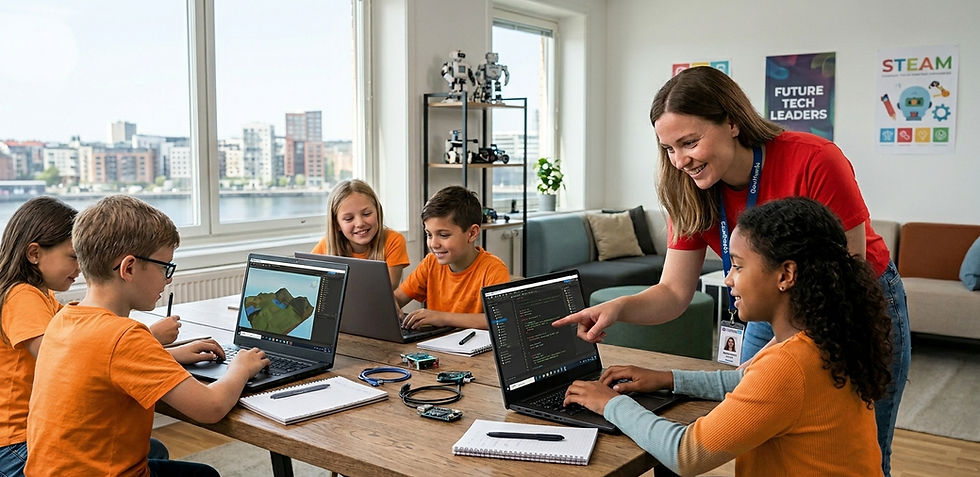
Technology, when used correctly, is far more than entertainment. It can be a powerful tool for creativity and skill-building. Learning coding, robotics, game development, or digital design helps children move from passive screen use to active creation. Instead of just consuming content, they begin to build games, robots, animations, and solutions.
Coding teaches logical thinking and builds patience, curiosity, and innovation. Robotics introduces engineering principles. Platforms like Roblox Studio and LEGO Robotics help children understand systems, testing, and improvement through experimentation. Children learn that mistakes are part of the process and that solutions often come through testing and revision.
The Shared Skills Between Sports and Tech
At first glance, football and coding may seem unrelated. But both develop surprisingly similar skills. A child learning to code must stay patient, adapt when something breaks, and keep trying until the solution works. A child learning a sport does the same through practice, repetition, and teamwork.
Both sports and technology teach persistence and problem-solving. And both require focus and self-discipline. Even leadership develops in both spaces. A child may lead a team during a game or guide a group project during a robotics challenge. In both situations, communication and confidence matter. When children experience both worlds, they become more adaptable and resilient learners.
Why Summer Camps Are the Best Place for This Balance
The future does not belong only to athletes or only to programmers. It belongs to individuals who can adapt, collaborate, and think creatively across different environments. One of the biggest challenges for parents is finding the right balance between physical activity and educational screen time especially during holidays. Too much passive screen use creates frustration, while overly rigid schedules can reduce enjoyment. A well-designed summer camp solves this by combining movement and creativity in the same environment.

At GowReads Summer Camp in Stockholm, children move between multisport sessions, outdoor games, LEGO Robotics, Roblox game development, coding projects, and creative activities. They are not separated into “sports kids” or “tech kids.” They are encouraged to explore both. This variety keeps children engaged because every part of the day offers something different. That is why the best summer experiences are not about choosing between sports and tech but helping children grow through both. Physical activity supports energy and focus, while technology sessions stimulate creativity and innovation. This leads to a more balanced learning experience.


Comments